Health and Safety Policy for Office Clearance Charlton
Purpose: This policy sets out the health and safety principles and practical requirements that govern safe office clearance and rubbish removal activities across our service area. It is written to ensure that all staff, contractors and on-site personnel understand their responsibilities and the controls in place to manage risks associated with clearing, transporting and disposing of office waste and unwanted furniture.
Scope and Responsibilities
This policy applies to all
office clearance operations, including
commercial office clearance, small business tidy-ups and set-piece clear outs. Responsibility for health and safety is shared across roles: senior management provides leadership and resources; supervisors ensure procedures are followed; employees and operatives must work safely and report hazards.
Office rubbish removal teams must follow safe systems of work and any permit-to-work or site-specific rules provided by client sites.

Risk Assessment and Planning
Prior to any waste clearance or removal, a formal risk assessment must be completed. Key assessments include manual handling, trip and fall risks, hazardous material identification and traffic/vehicle movements. The assessment must define control measures, which may include use of mechanical aids, buddy lifting, cordoning, signage and personal protective equipment. The following elements are essential:
- Identification of asbestos, chemical, electrical or sharps hazards;
- Assessment of access, stairways and confined spaces;
- Traffic management for loading and unloading zones;
- Waste segregation requirements to maximise recycling and minimise landfill.
Waste Handling and Segregation
Effective waste clearance requires clear procedures. Materials must be segregated at source where possible: cardboard and paper, metals, plastics, electronics (WEEE), and general non-recyclable waste.
Where hazardous or controlled wastes are encountered, work must stop until the material is identified and safe removal arranged. All handling and storage must prevent spillage and contamination.
Incident Reporting and Emergency Response
All incidents, including near-misses, must be reported immediately to the site supervisor and recorded. Emergency procedures include first aid provision, safe evacuation routes and procedures for spill containment. Operatives should be trained to:
- Provide immediate first aid where trained;
- Secure the scene and prevent additional exposures;
- Contact emergency services when required, and follow client site emergency protocols.
Equipment, Vehicles and PPE
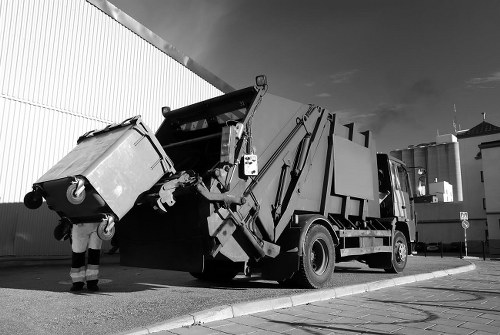
Only trained staff may operate powered equipment such as pallet trucks or tail-lift vehicles. Routine checks and maintenance are mandatory prior to use. Personal protective equipment must be provided and used where residual risks remain; typical PPE includes high-visibility clothing, gloves, steel-toe boots, eye protection and respiratory protection when dust or fumes are present.
Regular inspections ensure PPE remains fit for purpose.
Site Operations and Vehicle Safety
Loading and vehicle operations are controlled activities with elevated risk. A safe system of work covers vehicle positioning, load restraint, use of ramps and tail lifts, and supervision during loading. Drivers must ensure loads are secured and that weight limits are not exceeded.
Office clearance services must avoid obstructing walkways and must respect client time windows to reduce congestion and hazards on-site.

Training, Competence and Supervision
Training is central to safe waste clearance. Staff competence is maintained through planned induction, task-specific training and refresher sessions. Supervisors perform regular toolbox talks and on-site checks to confirm compliance with procedures. Records of training and qualifications are kept, and personnel are encouraged to raise safety concerns without fear of reprisal.
Continuous improvement is promoted through lessons learned from incidents and audits.
Monitoring, Compliance and Improvement
The company conducts regular audits, inspections and performance reviews to ensure safety standards are met and improved over time. Findings lead to corrective actions, updated risk assessments and revised procedures. The policy commits to the following practical measures:
- Maintain up-to-date risk assessments for all clearance types;
- Provide suitable PPE and equipment and ensure their correct use;
- Ensure all waste is handled and transported in compliance with environmental and safety norms;
- Keep training records and carry out regular competency assessments;
- Investigate incidents and implement corrective measures promptly.
Commitment and Review
The organisation recognises that effective health and safety management is integral to delivering reliable office clearance and rubbish removal services. This policy will be reviewed periodically and whenever there is a significant change in operations, legislation or following a serious incident. All employees and contractors must be familiar with the policy and contribute to a safe working environment by following its requirements and reporting hazards. Safety is a collective responsibility and forms the foundation of professional, efficient and sustainable waste and office clearance operations.
